Facts checked Article
Casino jackpot mechanics
How do progressive jackpots work in online casinos: the rules, read in three passes
Progressive jackpots in online casinos work in four parts — funding, trigger, eligibility and payment — and RTS 9 says the rules must be available before you stake. Here is how to read them in three passes.
How do progressive jackpots work in online casinos?
Progressive jackpots in online casinos work the way their rules say, and you do not have to guess how. Each part of the mechanism is written down, and under the Commission’s RTS 9 standard the rules must be available before you stake.
There are four parts. ① Funding is where the pool comes from. ② Trigger is what has to happen for it to be paid. ③ Eligibility is which stakes count. ④ Payment is what happens after a win.
The Gambling Commission’s standard for these systems is RTS 9. Its requirement 9A says an explanation of the jackpot rules ‘must be clearly available to the customer before they commit to gamble’. So the rules exist before the first spin.
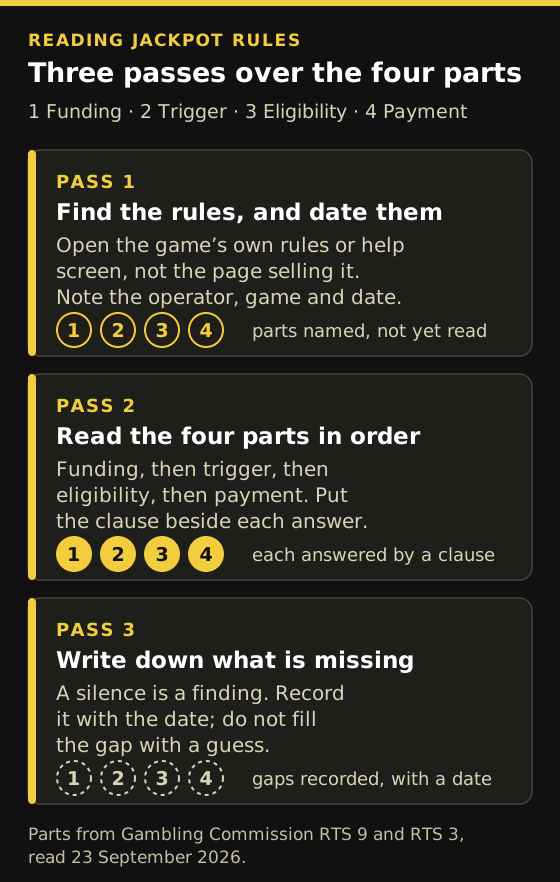
This page reads them in three passes: find and date the rules, read the four parts in order, then write down what the rules leave out.
Sources: Gambling Commission: RTS 9.
The four parts, and where each one is written down
- What a progressive jackpot is
- The Commission defines it as an incremental prize that grows from contributions out of the money staked, starting from a pre-set base value.Gambling Commission: RTS definition of terms · as checked on
- When the rules must be available
- RTS 9A: an explanation of the jackpot rules must be clearly available before the customer commits to gamble.Gambling Commission: RTS 9 · as checked on
- What the rules must describe
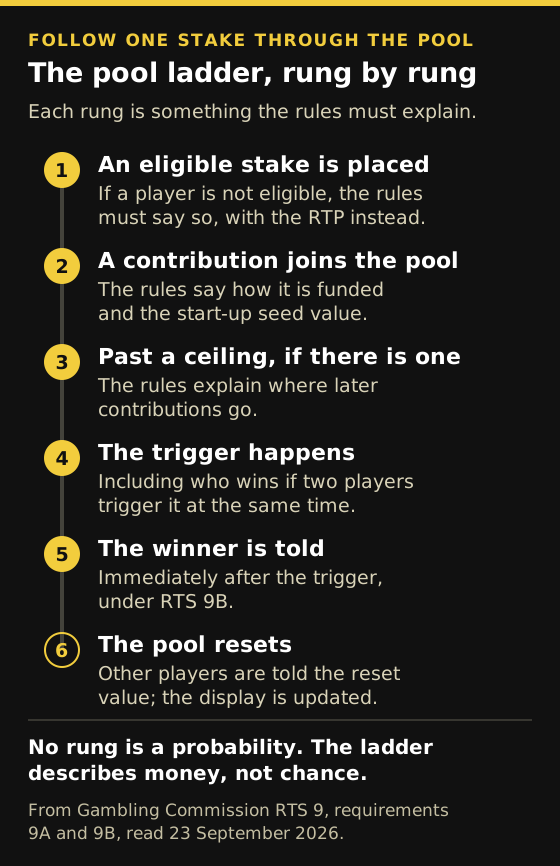
- Funding, the start-up seed, any ceiling, how prizes are determined and awarded, and what happens when two players trigger it at once.Gambling Commission: RTS 9 · as checked on
- What happens after a win
- RTS 9B: the winner is notified immediately, and other players are told the reset value.Gambling Commission: RTS 9 · as checked on
Regulator wording and operator terms read on 23 September 2026.
Pass 1 — find the rules the jackpot actually runs on
Start with the right document. RTS 3 guidance says explanatory content can sit in a game’s artwork, in ‘help’ or ‘how to play’ pages, or in other supporting material.
The same guidance lists whether there are contributions to jackpots, and how the jackpot operates, as items to consider including. So the place to look is the rules or help screen inside the game.
A lobby page about the jackpot is not the same document. It can be accurate and still leave out the clauses that settle a dispute. Treat it as an index, and the in-game rules as the source.
Write three things at the top of your notes: the operator, the game’s name and the date you read it. Rules change, and a clause is only as current as the day you saw it.
Sources: Gambling Commission: RTS 3.
① Funding — where the pool comes from
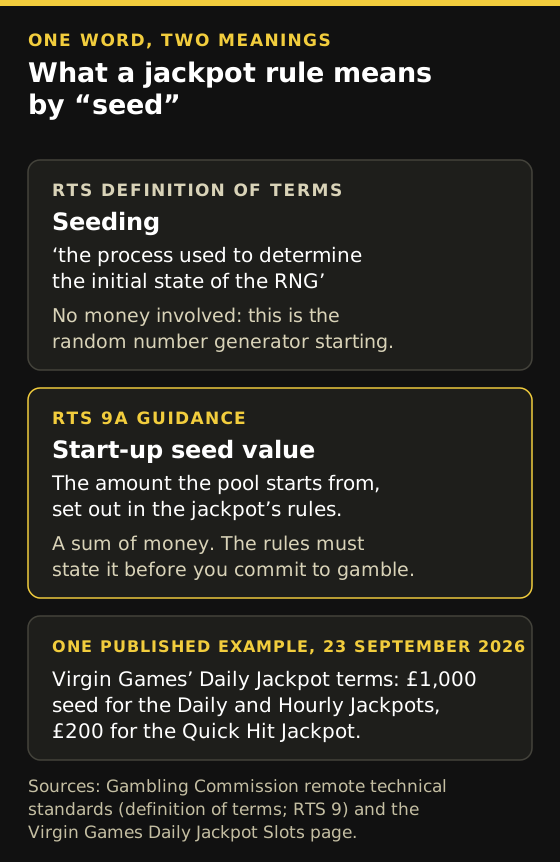
The Commission’s definition of terms calls a progressive jackpot ‘an incremental prize that increases as a result of contributions from the monies staked within a game from pre-set base value’. Put simply, part of each stake goes in, and the pool starts from a set amount.
RTS 9A guidance says the rules ‘shall describe how it is funded, what the start-up seed and any ceiling values are’. Where there is a ceiling, the rules should explain how later contributions are handled, for example through an overflow or reserve pool.
Here is one real example. Virgin Games’ Daily Jackpot terms, read on 23 September 2026, say a small percentage of every bet goes into a pot. The larger part grows the jackpots; the smaller part adds to a seed fund, which is the minimum prize.
The same terms put the seed at £1,000 for the Daily and Hourly Jackpots and £200 for the Quick Hit Jackpot. They also say there is no limit to the value of these jackpots. They do not give the percentage taken from each bet.
Every eligible spin funds the pool whether or not it wins, and the counter is designed to be watched. If watching it is why the next spin happens, GamCare’s helpline is 0808 8020 133.
Sources: Gambling Commission: RTS definition of terms; Gambling Commission: RTS 9; Virgin Games: Daily Jackpot Slots; Gambling Commission: self-exclusion; GamCare: talk to us now.
What the funding part of the rules has to say
The rules for a jackpot shall describe how it is funded, what the start-up seed and any ceiling values are.
② Trigger — what the terms say has to happen
The trigger is the event that awards the pool. RTS 9A guidance says the rules shall describe how prizes are determined and awarded. That includes what happens when two or more players trigger the same jackpot at once, or appear to, for example because of network latency.
In the Virgin Games terms, one tier can be won when three Jackpot symbols land on the reels, and prizes may also come from in-game features. The terms say the prizes are ‘initiated at random’. The Daily and Hourly Jackpots must also be won before a stated time.
On simultaneous wins, the same terms state: ‘The same jackpot cannot be won by two players simultaneously’. If two wins land close together, they are credited in the order they were won. That is exactly the kind of clause the second pass is looking for.
A deadline like that sets when a pool has to be paid. Our page on must-drop jackpot limits sets out what a clock or an amount cap can and cannot tell one player.
Sources: Gambling Commission: RTS 9; Virgin Games: Daily Jackpot Slots.
③ Eligibility — the stakes that count and the ones that do not
Eligibility decides whether your stake could win the pool at all. RTS 9A guidance says that if a player is not eligible for a game’s progressive jackpot prize, this should be made clear, along with their theoretical RTP.
RTP means return to player: the share of stakes a game is designed to pay back over a very large number of plays. An ineligible player is playing for a different RTP, and the rules should say what it is.
RTS 9B guidance adds two lines. A customer who contributes to a pool should be eligible to win it while playing that game. And ‘The chances of winning a jackpot should increase in correlation with the amount contributed’.
The Virgin Games page shows why this part needs care. Its main copy says you have ‘the same shot at the jackpot prize’ at 20p or £20 a spin. Its Daily Jackpot Terms say ‘the bigger your bet size, the more likely you are to win’.
Those two lines describe different models, and the page does not reconcile them. We have not tested the game, so we do not pick one. Record both, with the date, and check the rules inside the game.
Where a game asks you to opt in to a jackpot for an extra amount per spin, our page on an optional network jackpot contribution works out what that adds to your total stake.
Sources: Gambling Commission: RTS 9; Virgin Games: Daily Jackpot Slots.
Eligibility: four lines to find in the rules
From RTS 9A and 9B guidance, read 23 September 2026. Ticks stay in your browser and are not sent anywhere.
RTS 9A guidance asks for it to be made clear.
- Whether the jackpot is included in the stake or is an opt-in extra.
Ticks are kept only in this browser and are never sent anywhere.
④ Payment — notification, reset and where the money goes
RTS 9B guidance says the system shall notify a winning customer immediately after a jackpot is triggered. Other players must be adequately notified of the reset value. Under 9A, the displayed value should be updated as often as practicable, particularly after a reset.
The Virgin Games terms say a win is credited directly to the user wallet, even if it triggers during a bonus spin. They also warn that the jackpot value displayed may be different from the actual value.
A switched-off jackpot is part of payment too. RTS 9B says contributions in a decommissioned pool should be returned fairly, with priority to the players who made them. Its examples are waiting for the next award, moving the money to another jackpot, or a one-off return with disclosure.
None of this sets a withdrawal time. Identity checks and payment processing sit outside RTS 9, and our note on how progressive jackpots are paid out shows where that line falls.
Sources: Gambling Commission: RTS 9; Virgin Games: Daily Jackpot Slots.
Pass 3 — write down what the rules leave out
The third pass is a list of silences. A silence is a finding, so record it with the date rather than filling the gap with a guess.
Check the units first. The figure on screen may be cash, another currency or a game-specific unit, and the rules should say which. If they do not, leave that line visibly unresolved.
The parts list below is the result of all three passes on one real product page. It shows what a finished reading looks like, gaps included. For the wider picture of pools, triggers and prizes, see our guide to online casino jackpot rules.
Sources: Virgin Games: Daily Jackpot Slots.
The parts list: one jackpot page read in three passes
| Part | What RTS 9 asks the rules to say | What the page states | Evidence |
|---|---|---|---|
| ① Funding: seed | The start-up seed value | £1,000 for the Daily and Hourly Jackpots; £200 for the Quick Hit Jackpot | · Virgin Games: Daily Jackpot Slots |
| ① Funding: contribution | How the jackpot is funded | A small percentage of every bet; the percentage itself is not stated | · Virgin Games: Daily Jackpot Slots |
| ① Funding: ceiling | Any ceiling, and where later contributions go | No limit to the value of these jackpots | · Virgin Games: Daily Jackpot Slots |
| ② Trigger | How prizes are determined and awarded | Three Jackpot symbols or in-game features; initiated at random; Daily and Hourly must be won by a set time | · Virgin Games: Daily Jackpot Slots |
| ② Trigger: two at once | What happens if two players trigger it together | Cannot be won by two players simultaneously; credited in the order won | · Virgin Games: Daily Jackpot Slots |
| ③ Eligibility | Who is excluded, and the RTP they get instead | Two statements that disagree on bet size; no exclusions, and no RTP for excluded play, stated | · Virgin Games: Daily Jackpot Slots |
| ④ Payment | Winner told at once; others told the reset value | Credited directly to the user wallet; a notice shows when another player wins | · Virgin Games: Daily Jackpot Slots |
| ④ Payment: switch-off | A fair return if the jackpot is decommissioned | Not stated; a temporary switch-off pauses contributions and keeps the value | · Virgin Games: Daily Jackpot Slots |
This is the table to keep. A blank cell is a result, not an omission.
How to read a jackpot’s rules in three passes
The steps below are the whole method on one screen. Keep a note open beside the game while you work.
The same four questions answer how do progressive jackpots work in online casinos for any jackpot, whichever operator runs it. Only the answers change.
Sources: Gambling Commission: RTS 3; Gambling Commission: RTS 9.
Reading a progressive jackpot’s rules, pass by pass
Five steps, in order. The parts come from RTS 9, read 23 September 2026.
Open the rules inside the game
Use the game’s rules, help or ‘how to play’ screen. RTS 3 guidance names these as places explanatory content can sit.
A promotional page is an index, not the source.
Date what you read
Write the operator, the game’s name and today’s date at the top of your notes.
Read the four parts in order
Funding, then trigger, then eligibility, then payment. Copy the clause or line that answers each one.
List the silences
Units, ceiling handling, simultaneous triggers, excluded stakes and switch-off: note each one the rules do not answer.
What the result means
You now know how this jackpot is funded, triggered, limited and paid. You do not know when it will next be won, and nothing in the rules says so.
A worked summary, with invented amounts
The last step is a short summary in your own words. Use invented amounts and label them as illustrative, so no one mistakes them for a real pool.
For example, and the amounts here are made up: a pool starts at a £500 seed. Eligible stakes add to it until it shows £2,300. The trigger in the rules awards it, and it resets to £500.
That summary describes money moving, and nothing else. It says nothing about when the next award comes, and it suggests no way to force one. If a line in your summary starts to sound like a prediction, cut it.
Before you trust your summary
Each line comes from RTS 9 or from the method above. Ticks stay in your browser and are not sent anywhere.
RTS 9A guidance asks for both to be made clear.
- Every amount in your summary is marked as real, with a date, or as invented.
Ticks are kept only in this browser and are never sent anywhere.
What the counter cannot tell you
A jackpot counter shows the pool’s current size. RTS 9A asks for it to be kept up to date, especially after a reset. That is a display duty, not a forecast.
The counter does not show the trigger, your eligibility or the payment route. Those three parts live only in the rules. Our page on why a jackpot counter is not a probability takes the display apart in more detail.
Choosing not to stake at all is always a valid result of reading the rules. The four parts are worth knowing either way.
Sources: Gambling Commission: RTS 9.
Words used on this page
- Progressive jackpot
- A prize that grows from contributions taken out of the money staked, starting from a pre-set base value. This is the Commission’s definition, read 23 September 2026.
- Seed
- In jackpot rules, the start-up amount the pool begins from. In the Commission’s definition of terms, seeding means something else: setting the starting state of the random number generator.
- Ceiling
- A cap on the pool. Where one exists, RTS 9A guidance asks the rules to say where later contributions go.
- Eligible stake
- A stake that can win the jackpot. If yours cannot, the rules should say so and give the RTP you are playing for instead.
- RTS
- The Gambling Commission’s remote gambling and software technical standards. RTS 9 covers progressive jackpot systems; RTS 3 covers rules and game descriptions.
- RTP
- Return to player: the share of stakes a game is designed to pay back over a very large number of plays. It is not a forecast for one session.
- Must-drop
- A jackpot whose rules say it has to be won by a set time or before it reaches a set amount.
- Self-exclusion
- A formal agreement not to gamble with an operator or across operators for a set period. The Commission’s page on it also gives the 24-hour helpline number.
- Decommissioning
- Switching a jackpot off for good. RTS 9B asks for the money in it to be returned fairly to the players who paid in.
Terms read 23 September 2026
Seven pages were opened on 23 September 2026. Every clause and figure above comes from one of them, or is marked as an invented example.
RTS 9 supplied the four parts, the eligibility and correlation lines, the notification duty and the switch-off routes. RTS 3 supplied where explanatory content can sit. The Commission’s definition of terms supplied what a progressive jackpot is.
The Virgin Games Daily Jackpot Slots page supplied the operator example, and the public register showed its operator, Gamesys Operations Limited, holding an active remote casino licence that day. The Commission’s self-exclusion page and GamCare’s support page supplied the helpline number.
We did not open the in-game rules, stake, deposit or withdraw anything to write this page. The £500 and £2,300 in the worked summary are invented.
Sources: Gambling Commission: RTS 9; Gambling Commission: RTS 3; Gambling Commission: RTS definition of terms; Virgin Games: Daily Jackpot Slots; Gambling Commission register: 38905; Gambling Commission: self-exclusion; GamCare: talk to us now.
Questions answered
How do progressive jackpots work in online casinos?
Part of each eligible stake goes into a pool that starts from a seed value. The pool is paid when the trigger in the rules happens, then resets. RTS 9 requires those rules — funding, seed, ceiling, trigger and eligibility — to be available before you commit to gamble.
Where do I find a progressive jackpot’s rules?
In the game’s own rules, help or ‘how to play’ screen. RTS 3 guidance names these as places explanatory content can sit. A promotional page about the jackpot is a separate document and may leave clauses out.
Does a bigger stake change my chance of winning a progressive jackpot?
RTS 9B guidance says the chances of winning a jackpot should increase in correlation with the amount contributed. The Virgin Games page we read on 23 September 2026 says both that bet size makes no difference and that a bigger bet makes a win more likely, so check the rules inside the game.
What happens if two players trigger a progressive jackpot at the same time?
RTS 9A guidance says the rules must describe it. Virgin Games’ terms, read 23 September 2026, say the same jackpot cannot be won by two players simultaneously, and that wins close together are credited in the order they were won.
Does a bigger jackpot counter mean a win is closer?
No. RTS 9A asks for the displayed value to be kept up to date after a reset. It shows the pool’s size, and nothing in the standard ties that size to when the next award comes.
Rule documentation
Continue reading
A jackpot counter is not a probability
The Gambling Commission's technical glossary describes a progressive jackpot as a prize that grows from a preset base through contributions from amounts staked.
Read A jackpot counter is not a probability
Best progressive jackpot slots: the four parts, from the terms
The best progressive jackpot slots are the ones whose funding, trigger, eligibility and payment terms you can read before you spin. Two named systems taken apart from their published terms on 21 September 2026, with the gaps marked.
Read Best progressive jackpot slots: the four parts, from the terms
A must-drop jackpot needs a deadline or an amount threshold
Compare documented timed, amount-bounded and uncapped jackpot products. A worked counter example shows why the remaining gap does not reveal your win chance.
Read A must-drop jackpot needs a deadline or an amount threshold
An optional jackpot contribution belongs in the total stake
Use a documented 10p jackpot addition to separate base stake, total commitment and eligibility. Worked examples explain percentage shares without promising prizes.
Read An optional jackpot contribution belongs in the total stake
The disclosures a progressive jackpot has to make before it pays out
RTS 9 sets out what a jackpot's rules must disclose about funding, ceilings, simultaneous triggers and decommissioning. We check two real product pages against it.
Read The disclosures a progressive jackpot has to make before it pays out
Online casino jackpots explained: the pool, the trigger and the prize
Separate a jackpot’s funding from its eligibility and award rules, with a contribution worksheet and a close reading of Virgin Games and Red Tiger descriptions.
Read Online casino jackpots explained: the pool, the trigger and the prize
Continue reading
Best progressive jackpot slots: the four parts, from the terms
The best progressive jackpot slots are the ones whose funding, trigger, eligibility and payment terms you can read before you spin. Two named systems taken apart from their published terms on 21 September 2026, with the gaps marked.
Read Best progressive jackpot slots: the four parts, from the termsA must-drop jackpot needs a deadline or an amount threshold
Compare documented timed, amount-bounded and uncapped jackpot products. A worked counter example shows why the remaining gap does not reveal your win chance.
Read A must-drop jackpot needs a deadline or an amount thresholdAn optional jackpot contribution belongs in the total stake
Use a documented 10p jackpot addition to separate base stake, total commitment and eligibility. Worked examples explain percentage shares without promising prizes.
Read An optional jackpot contribution belongs in the total stakeA jackpot counter is not a probability
The disclosures a progressive jackpot has to make before it pays out
Best progressive jackpot slots: the four parts, from the terms
A must-drop jackpot needs a deadline or an amount threshold
Online casino jackpots explained: the pool, the trigger and the prize