Payout mechanics
The disclosures a progressive jackpot has to make before it pays out
RTS 9 sets out what a jackpot's rules must say about funding, ceilings, simultaneous triggers and decommissioning. Two real product pages show how little of that reaches the page you actually read.
"Paid out" is two different questions
Searches for how a progressive jackpot is paid out usually want one of two answers, and most explainers only give the first. The first is mechanical: what event has to happen for a pool to be awarded, and what does the rule document say happens next. The second is procedural: once a win is confirmed, how long before the money is actually usable, and what checks sit in between.
This article is about the first question. The UK Gambling Commission's remote technical standards put a disclosure duty on the game itself — what its rules have to say, and when. The second question, how a confirmed win clears into a withdrawable balance, runs through identity verification and payment processing that our note on the jackpot counter deliberately leaves alone, and that Payout Ledger covers as its own territory.
Keeping the two apart matters because a jackpot page can satisfy one and say nothing about the other. A page can tell you exactly when a pool resets and never mention how long a payment review takes. Neither answer excuses the other's silence.
What RTS 9 makes the rules say before you play
RTS 9 is the Gambling Commission's technical standard for progressive jackpot systems, part of the remote gambling and software technical standards that licensed operators and their game suppliers must meet. Its first requirement, numbered 9A, is that "an explanation of the jackpot rules must be clearly available to the customer before they commit to gamble." That is a timing rule as much as a content rule: the explanation has to exist before the stake is placed, not after a query is raised.
The implementation guidance under 9A sets out what that explanation has to cover. The rules must describe how the jackpot is funded, its start-up seed value, and any ceiling; where a game shows a combined return to player figure or a separate jackpot component, that has to follow the disclosure format set out in RTS 3. Where a ceiling exists, the rules must explain what happens to contributions once the pool reaches it — redirected to a reserve, held back, or handled some other stated way.
The same guidance requires the current jackpot value to be visible to all eligible players and "updated as frequently as is practicable, particularly after the amount has been reset following a win." That is worth separating from probability entirely: the requirement is about the display staying honest about the pool's state, not about giving players a signal of how close an award is.
Sources: UK Gambling Commission: RTS 9 — Progressive jackpot systems, retrieved 19 September 2026.
Who actually won: simultaneous triggers
A progressive jackpot usually sits behind more than one player at once, and on a busy network two spins can appear to land the triggering event within the same instant. The implementation guidance under RTS 9A requires the rules to set out how that is resolved: what happens when two or more players simultaneously trigger the same jackpot, or appear to because of network latency, and how the game determines and awards the prize in that situation.
None of this is answerable by watching the screen. A screen shows what was displayed to one player at one moment; it cannot show the server-side sequencing that the rules are required to define. If a genuine dispute over a near-simultaneous trigger arises, the applicable rule text — not a recollection of what appeared to happen — is the only thing that resolves it.
This is also why identifying the exact game version and rule set matters more for a jackpot than for most other casino products. The same jackpot brand can sit inside more than one implementation, and the simultaneous-trigger clause is exactly the kind of detail that can differ between them without the branding changing at all.
Sources: UK Gambling Commission: RTS 9 — Progressive jackpot systems, retrieved 19 September 2026.
Notification: how fast, and who else is told
RTS 9's second requirement, numbered 9B, concerns fairness and security in how the system operates rather than what it discloses in advance. One part of the implementation guidance is specific about timing on the other side of an award: the system must ensure a winning customer is notified of a jackpot win immediately after it is triggered, and that other participating customers are adequately notified that the jackpot's value has reset.
Read alongside the current-value requirement in part two, this closes a loop. The pool has to be shown accurately while it grows, the win has to be flagged to the winner without delay once it happens, and everyone else still playing against that pool has to be told it has gone back to its post-award value. A jackpot product that is slow to update its counter after a win, without explanation, is not meeting the spirit of a standard built around exactly that moment.
None of this states a payment timeframe. Immediate notification that a jackpot was triggered is not the same as immediate availability of the funds, and RTS 9 does not claim to cover the second.
Sources: UK Gambling Commission: RTS 9 — Progressive jackpot systems, retrieved 19 September 2026.
What happens when a jackpot is switched off
Jackpot networks are commercial products and they do get retired — a provider drops a title, an operator's contract with a network ends, or a game is withdrawn. RTS 9B's guidance addresses this directly: where a jackpot with player contributions in it is decommissioned, the standard calls for a fair return that prioritises the players who contributed to it, through one of several stated routes — leaving the pool to be awarded on its existing schedule, transferring it into a similar pool, or a one-off disbursement, with the choice disclosed.
What the standard does not do is fix which of those routes an operator has to choose, or set a value formula for a one-off disbursement. That is a real gap, and it is the kind of gap that only shows up when a specific jackpot is actually wound down — at which point the operator's own communication about it, not a general standard, is the primary source worth reading.
If you are trying to establish what happened to a specific pool that disappeared from a lobby, the questions to ask are the same three the standard names: was the pool paid out, transferred, or disbursed, and which of those was disclosed to contributing players at the time.
Sources: UK Gambling Commission: RTS 9 — Progressive jackpot systems, retrieved 19 September 2026.
Eligibility and the RTP you don't see
The same 9A guidance that requires funding and ceiling disclosure also requires something narrower and easy to miss: if a player is not eligible for a game's progressive jackpot prize, that has to be made clear, together with the theoretical return to player they get instead. In other words, a game that excludes some stakes or some play modes from the jackpot is required to say so, and to say what those excluded players are actually playing for.
This is a different claim from a general return-to-player figure, which Odds & Ends Lab covers as a concept in its own right; here the relevant fact is narrower still — whether a specific stake or mode falls inside or outside a specific jackpot's eligible pool, and what the rules say the alternative RTP is when it does not.
Minimum-bet eligibility is where public pages and in-game rules have been seen to disagree outright. Virgin Games' own Daily Jackpot Slots page states in its main explanation that stake size does not affect the odds — "whether you're playing at 20p or £20 per spin, you've got the same shot at the jackpot prize as everyone else" — while the Daily Jackpot Terms section on the same page says "the bigger your bet size, the more likely you are to win one of our Daily Jackpots." Those two sentences describe different eligibility models, and the page does not reconcile them. We have not tested the live game to resolve which applies, and this article does not pick one for you.
Sources: Virgin Games: Daily Jackpot Slots and Daily Jackpot Terms, retrieved 19 September 2026.
The audit: two real pages against the checklist
To see how much of RTS 9's disclosure duty actually surfaces on a page a UK player would land on, we read two real, named jackpot products against the checklist above: Virgin Games' Daily Jackpot Slots and Hourly Jackpot, and the Daily Drop Jackpots network that Evolution's own brands page attributes to Red Tiger. Both pages were retrieved on 19 September 2026. The table below states only what each page itself contains — not what the underlying game's in-client rules tab may say, which we did not access.
| RTS 9 disclosure element | What the standard asks for | Virgin Games: Daily Jackpot Slots (public page) | Evolution: Red Tiger Daily Drop Jackpots (public page) |
|---|---|---|---|
| Seed value | Starting amount the pool is funded from | Stated: "The seed value of the Daily and Hourly Jackpots is £1,000," and £200 for the Quick Hit Jackpot. | Not stated. The page names the network but gives no seed figures. |
| Ceiling | Any cap, and where overflow contributions go | Stated as absent: "There is no limit to the value of these jackpots." | Not stated. |
| Minimum bet / eligibility | Whether a stake or mode is excluded from the pool | Contradictory on the same page: the main copy says stake size makes no difference; the Daily Jackpot Terms say a bigger bet makes winning more likely. | Not stated. |
| RTP for ineligible players | Theoretical return offered instead, where excluded | Not stated anywhere on the page. | Not stated. |
| Simultaneous-trigger handling | How the system resolves near-simultaneous wins | Not stated. | Not stated. |
| Payout crediting | How and when a win reaches the player | Stated: "the amount will be credited directly to the user wallet, even if it is triggered while a bonus spin is being played." | Not stated. |
| Decommissioning route | What happens to a pool if the jackpot is withdrawn | Not stated. | Not stated. |
Read across the table, the pattern is consistent rather than surprising: consumer-facing pages disclose the figures that sound good — a headline seed value, an uncapped ceiling, a wallet-credit promise — and are silent on the clauses RTS 9 actually requires for a dispute to be resolved, such as simultaneous-trigger handling and decommissioning. That is not evidence either operator or provider is non-compliant; RTS 9's duty attaches to the game's own rules, which the standard requires to be available before you commit to gamble, not to the marketing page that sits in front of it. It is evidence that the two are routinely different documents, and that only one of them is the one worth citing.
Where to actually find the missing clauses
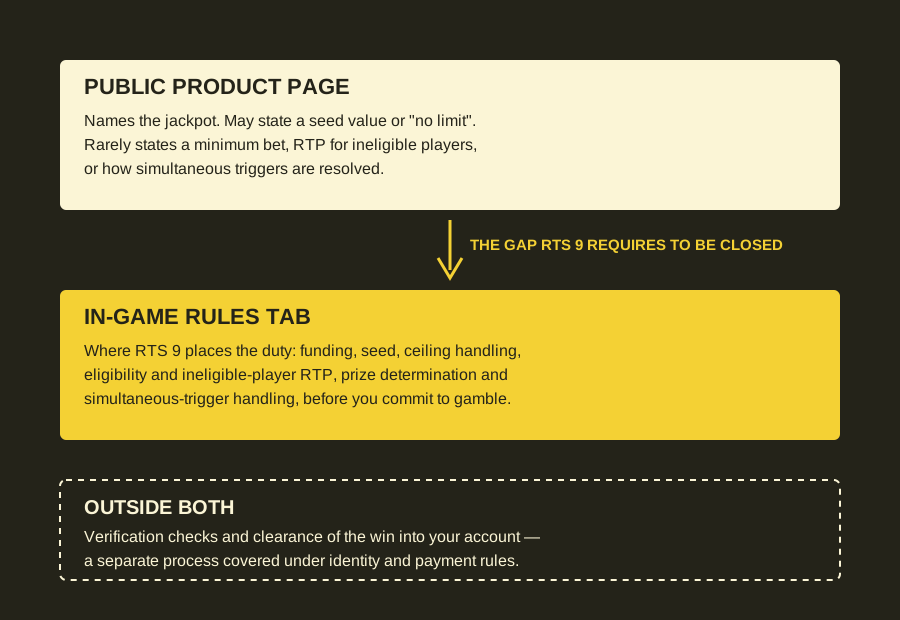
If a public page is silent on eligibility, simultaneous triggers or decommissioning, that information has not necessarily been withheld — RTS 9 places the duty on the rules "available to the customer before they commit to gamble," which in practice means the in-game rules or paytable screen, opened from inside the game client itself, not the operator's promotional page about it. The practical method is to open that screen, screenshot or save the relevant clause with the date, and treat the marketing page as an index rather than a source.
Where the in-game rules also fall silent on a specific point — say, the exact overflow destination once a ceiling is reached — that silence is itself the finding. RTS 9 requires an explanation to exist; it does not guarantee a reader will find it. Recording the exact game version, operator and date you looked is what lets someone else check whether that has since changed.
None of this tells you when a confirmed win becomes spendable money. That question sits with identity verification and payment processing, which this site does not cover in depth; if you are chasing a stalled payout rather than an eligibility clause, that is the more useful next document to read.
Rule documentation
- UK Gambling Commission: RTS 9 — Progressive jackpot systems — retrieved 19 September 2026.
- Virgin Games: Daily Jackpot Slots and Daily Jackpot Terms — retrieved 19 September 2026.
- Evolution: Brands — Red Tiger — retrieved 19 September 2026.