Facts checked Article
Casino jackpot mechanics
An optional jackpot contribution belongs in the total stake
Use a documented 10p jackpot addition to separate base stake, total commitment and eligibility. Worked examples explain percentage shares without promising prizes.
The extra entry is a separate price
An optional jackpot can add money to an online slot's selected stake. Read that addition as part of the amount committed, rather than assuming that the base-game figure is the full cost of a round. The jackpot eligibility condition and the base-game stake need separate entries in the same record.
Sky Vegas' public Big Drop FAQ provides a concrete example: participation requires opting in, and eligible rounds add a fixed £0.10 contribution to the selected stake. The FAQ also says the opt-in remains active until the customer opts out.
These are terms for that named product, checked on 19 September 2026; they are not a description of all network jackpots or a claim about an account we tested.
The question here is what that extra contribution means for cost and eligibility. It is distinct from the deadline or ceiling at which a must-drop prize is awarded, and from the process for validating a large win. No account was opened and no game was played.
All numerical examples use paper inputs and make no promise of a prize.
Sources: The Big Drop - FAQs.
① Funding — the optional contribution as the FAQ states it
- The addition
- Sky Vegas' public Big Drop FAQ says participation requires opting in, and eligible rounds add a fixed £0.10 contribution to the selected stake.The Big Drop - FAQs · as checked on
- Where it belongs
- Read that addition as part of the amount committed, rather than assuming the base-game figure is the full cost of a round.The Big Drop - FAQs · as checked on
- The opt-in
- The FAQ also says the opt-in remains active until the customer opts out.The Big Drop - FAQs · as checked on
- What these terms are not
- Not a description of all network jackpots, and not a claim about an account we tested. The addition is distinct from a must-drop deadline or ceiling and from the validation of a large win.The Big Drop - FAQs · as checked on
Terms for one named product, taken from its public FAQ. No account was opened and no game was played; all numerical examples use paper inputs.
Name the prize layer before counting contributions
A slot can have its own prize features while a separate network feature adds another eligibility condition. Sky's Big Drop page says its opt-in does not affect the base game's outcome and distinguishes it from games' own jackpots and other network jackpots. That is a product description, not a measured comparison of random-number systems.
The distinction prevents an overly broad note such as jackpots off. The useful note names which optional feature is off, which game is being described and what the product's terms say follows. A different jackpot printed within the game's rules cannot be classified solely from another feature's switch.
Sky's general jackpots help page also distinguishes fixed non-progressive awards from progressive ones. That classification concerns the prize amount's structure, while an opt-in condition concerns participation. Neither label, by itself, states whether money is added to the selected base stake.
Keep the classifications separate: prize structure, entry condition, contribution amount and award rule. Combining them into one headline description is how an advertised prize can obscure the actual amount committed.
Sources: The Big Drop - FAQs; Jackpots.
Calculate the addition in pounds and as a share
Our cost worksheet uses a fixed 10p addition, matching the named FAQ's stated contribution. The base stakes are hypothetical amounts chosen for comparison, not confirmation of available denominations. Every row assumes an eligible paid round with the addition actually applied.
Two percentages answer different questions. On the first row, 10p divided by the 20p base is a 50% increase. The same 10p divided by the 30p total is one third of the money committed.
Describing both as the jackpot percentage would hide the denominator.
The pounds added do not change across the rows. A smaller percentage beside the larger base stake is not a discount on the contribution: it is the same 10p divided by a larger amount. Increasing the base stake merely to make that percentage smaller increases total commitment.
This worksheet is cost disclosure, not advice to choose a denomination.
| Illustrative base stake | Additional contribution | Total commitment | Increase over base | Contribution share of total |
|---|---|---|---|---|
| £0.20 | £0.10 | £0.30 | 50% | 33.33% |
| £0.50 | £0.10 | £0.60 | 20% | 16.67% |
| £1.00 | £0.10 | £1.10 | 10% | 9.09% |
Sources: The Big Drop - FAQs.
Count only the rounds that actually qualify
For an entirely fictional record of twenty eligible paid rounds with a 50p base and a 10p addition, the base stakes total £10 and the contributions total £2. Combined commitment is £12 before any returns. The number twenty was selected for simple multiplication; it is not a measured session length or a suggested amount of play.
Now change the record to twelve rounds with the contribution applied and eight without it, keeping the hypothetical base stake at 50p. Base commitment remains £10, contributions become £1.20, and combined commitment becomes £11.20. Multiplying all twenty rounds by 10p would overstate the contributions by 80p in this constructed record.
This is why participation status belongs beside the round count. A displayed feature, a saved preference and an applied contribution are not interchangeable pieces of evidence. For an actual account reconciliation, use the record of contributions and the product's eligibility conditions.
If the interface only supplies a period total, do not invent the individual qualifying rounds. The worksheet can retain an unknown count while still recording a known monetary total.
Sources: The Big Drop - FAQs.
③ Eligibility — two fictional records at a 50p base plus 10p
| Fictional record | Base commitment | Contributions | Combined commitment | Evidence |
|---|---|---|---|---|
| Twenty eligible paid rounds, contribution applied to every one | £10 | £2 | £12 | · The Big Drop - FAQs |
| Twelve rounds with the contribution applied and eight without | £10 | £1.20 | £11.20 | · The Big Drop - FAQs |
Multiplying all twenty rounds by 10p would overstate the contributions by 80p in the second record. If the interface only supplies a period total, do not invent the individual qualifying rounds; the worksheet can retain an unknown count while recording a known monetary total.
The eligibility exceptions are part of the rule
The Big Drop FAQ says that play without the jackpot widget does not qualify and that free-spin and bonus rounds do not contribute. It also describes a case where adding the contribution would exceed the allowed stake limit: the contribution is not applied for that round. Those statements qualify the broad description of an active opt-in.
Do not expand free-spin and bonus-round wording into a rule covering every possible bonus-money balance. Those are different claims. This research did not establish a complete bonus-wallet policy for every participating game, so the article makes no universal claim about promotional funds.
Likewise, it does not turn a general stake-limit exception into a legal explanation of a particular customer's limit.
A useful document comparison records the exact exclusion, its stated consequence and any uncertainty. For example, distinguish contribution not applied from base round cancelled if the source specifies only the former. If a product description leaves an important case unanswered, the correct entry is unresolved.
Guessing the missing rule from another network could alter both the total cost and the claimed eligibility.
Sources: The Big Drop - FAQs.
③ Eligibility — the exceptions the FAQ states
These statements qualify the broad description of an active opt-in. Record the exact exclusion, its stated consequence and any uncertainty; distinguish contribution not applied from base round cancelled if the source specifies only the former.
Ticks are kept only in this browser and are never sent anywhere.
A contribution is not a personal savings balance
Paying into a prize system does not create a personal pot that grows towards a guaranteed payout. The named FAQ says awards are random and not guaranteed. Contributions and returns therefore belong in separate columns, even if the interface presents progress or a growing shared amount.
In our twenty-round paper example, £2 in contributions establishes £2 committed to the optional feature. It does not establish £2 due back to that customer, a minimum award, or how close the customer is to receiving a prize. The hypothetical ledger contains no probability model and cannot supply one by multiplying round count by stake.
Nor should the displayed growth of a jackpot be used to reconstruct an individual's contributions. A shared pool can receive activity from elsewhere, and the product describes more than one use for contributed funds. We have not converted the displayed pool movement into a contribution rate or independently audited its funding.
This article's cost worksheet needs only the stated per-round charge and an explicitly assumed number of qualifying rounds; it makes no claim about the live counter's movement.
Sources: The Big Drop - FAQs.
Keep return percentages attached to their components
RTS 9 guidance permits the return-to-player information for a progressive system to be presented as a combined figure or broken into base-game and jackpot components. It also addresses the information given when someone is ineligible. This provides a disclosure framework; it is not a certification that a particular public FAQ fully implements every requirement.
When two separate percentages are supplied, their labels matter. A base-game figure describes a different component from an optional contribution figure. Adding them together is not a combined return, and taking a simple average ignores how much is staked on each.
This article does not calculate a named game's combined RTP because no complete, matched base-game configuration was checked.
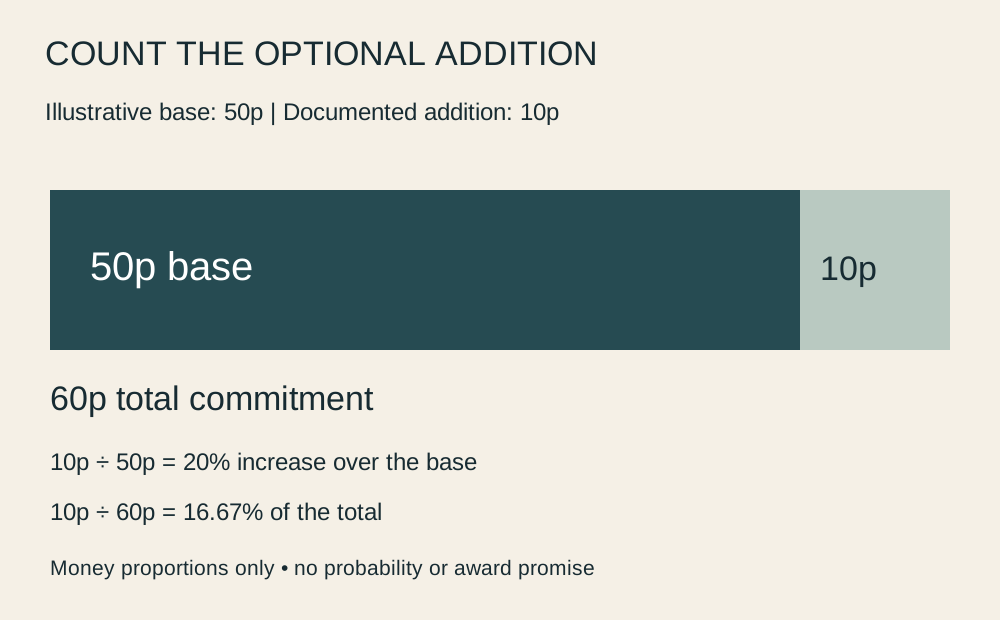
The cost table nevertheless identifies the weights such a calculation would need. A hypothetical 50p base plus 10p contribution allocates five sixths of the total stake to the base and one sixth to the addition. Those are money proportions, not chances of receiving either prize.
Without the matching component assumptions, leave the combined-return field blank. A blank, explained field is more useful than a precise-looking number assembled from incompatible products.
Sources: RTS 9 – Progressive jackpot systems.
Parts and terms used on this page
- Optional jackpot
- A prize layer a customer opts into, with its own eligibility condition and, in the named product, its own addition to the selected stake.
- Contribution
- The fixed amount added to an eligible round's stake for the optional feature; money committed, not a personal balance.
- Contribution rate
- The share of each eligible stake that goes to the pool; this article does not derive one from the displayed counter.
- Progressive
- A prize whose amount grows as contributions arrive, as opposed to a fixed non-progressive award.
- Must-drop
- A jackpot awarded by a deadline or a ceiling; a different mechanism from the opt-in contribution discussed here.
- RTP
- Return to player: the share of stakes a game is designed to return over a very long run, stated per component or as a combined figure.
- RTS
- The Gambling Commission's remote gambling and software technical standards; RTS 9 covers progressive jackpot systems.
A short record is more useful than a large counter
The final record should identify the named jackpot layer, the contribution, the total stake, the opt-in state, the qualifying-round conditions and where contributions can be checked. Sky's FAQ points customers to transaction history for their contribution total. We did not access that history or verify its layout; the observation concerns the published instruction only.
For an independent document review, retain the retrieval date and distinguish what the source states from calculations made from it. Our original figure illustrates a 50p base plus a 10p addition making a 60p commitment. It is a labelled accounting diagram, not a product screen, price offer or representation of a live jackpot meter.
This method adds one necessary number to a tempting headline: the amount actually committed. It does not identify a better time to participate or imply that previous contributions improve a customer's entitlement. The examples can be checked on paper, and opting into additional gambling is not needed to understand them.
Gambling can cause harm; a shared prize pool is not a personal financial plan.
Sources: The Big Drop - FAQs.
How to build the short record
The record the prose above describes. The examples can be checked on paper, and opting into additional gambling is not needed to understand them.
Name the jackpot layer
Identify the named jackpot layer rather than a general note such as jackpots off, and say which game is being described.
Enter the contribution and the total stake
Record the per-round contribution and the total stake with it included as separate entries: in the paper example, a 50p base plus a 10p addition making a 60p commitment.
Record the opt-in state
Note whether the opt-in was active. A displayed feature, a saved preference and an applied contribution are not interchangeable pieces of evidence.
Record the qualifying-round conditions
The jackpot widget shown, a paid round rather than a free-spin or bonus round, and the stake limit not exceeded, as the FAQ states them.
Say where contributions can be checked
Sky's FAQ points customers to transaction history for their contribution total. Retain the retrieval date and distinguish what the source states from calculations made from it.
What the result means
The record adds one necessary number to the headline: the amount actually committed. It does not identify a better time to participate or imply that previous contributions improve an entitlement.
Questions answered
Do I need to opt in to The Big Drop?
Yes, according to the named Sky FAQ. It adds a fixed 10p contribution on qualifying rounds; this is a documented product condition, not a rule for every jackpot.
Will I need to opt out if I don't wish to continue with The Big Drop?
The FAQ says the opt-in remains active until the customer opts out. It also gives round-specific exclusions, so an active preference alone is not a complete contribution record.
How will I know if a game is eligible?
The named FAQ points to the in-game jackpot toggle and eligible-game list, and says absence of the widget means that game’s rounds do not qualify. We did not test the interface.
How do I find out how much I've contributed to The Big Drop?
The FAQ directs customers to transaction history. Our paper examples show how to total confirmed contributions; they do not claim access to an account or prescribe more play to obtain evidence.
Is the 10p contribution part of my stake?
Yes, in the named product. The FAQ describes a fixed addition to the selected stake on eligible opted-in rounds, so the amount committed for a round is the base stake plus the contribution, not the base-game figure alone.
Why does the percentage look smaller on a bigger base stake?
Because the same 10p is divided by a larger amount. It is not a discount on the contribution, and increasing the base stake merely to make that percentage smaller increases the total commitment.
Does paying contributions build up a pot that is owed to me?
No. The named FAQ says awards are random and not guaranteed. In the twenty-round paper example, £2 in contributions establishes £2 committed to the optional feature, not £2 due back, a minimum award or how close a prize is.
Rule documentation
Continue reading
A jackpot counter is not a probability
The Gambling Commission's technical glossary describes a progressive jackpot as a prize that grows from a preset base through contributions from amounts staked.
Read A jackpot counter is not a probability
Read jackpot rules in three passes
Begin with how the pool is funded, its starting value, and any cap.
Read Read jackpot rules in three passesA must-drop jackpot needs a deadline or an amount threshold
Compare documented timed, amount-bounded and uncapped jackpot products. A worked counter example shows why the remaining gap does not reveal your win chance.
Read A must-drop jackpot needs a deadline or an amount threshold
The disclosures a progressive jackpot has to make before it pays out
RTS 9 sets out what a jackpot's rules must disclose about funding, ceilings, simultaneous triggers and decommissioning. We check two real product pages against it.
Read The disclosures a progressive jackpot has to make before it pays out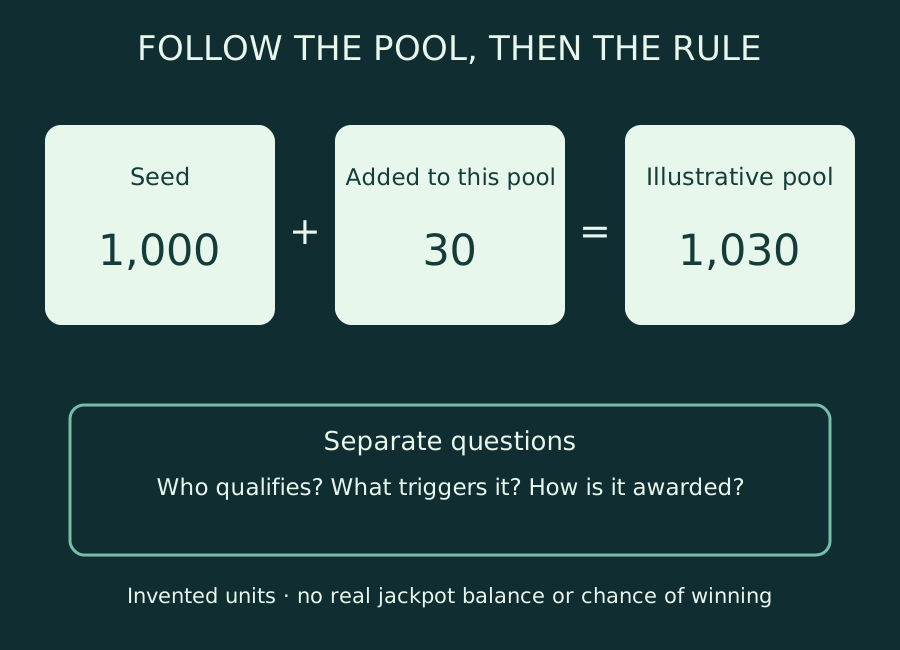
Online casino jackpots explained: the pool, the trigger and the prize
Separate a jackpot’s funding from its eligibility and award rules, with a contribution worksheet and a close reading of Virgin Games and Red Tiger descriptions.
Read Online casino jackpots explained: the pool, the trigger and the prize
Continue reading
A must-drop jackpot needs a deadline or an amount threshold
Compare documented timed, amount-bounded and uncapped jackpot products. A worked counter example shows why the remaining gap does not reveal your win chance.
Read A must-drop jackpot needs a deadline or an amount thresholdA jackpot counter is not a probability
The Gambling Commission's technical glossary describes a progressive jackpot as a prize that grows from a preset base through contributions from amounts staked.
Read A jackpot counter is not a probabilityRead jackpot rules in three passes
Begin with how the pool is funded, its starting value, and any cap.
Read Read jackpot rules in three passesA jackpot counter is not a probability
Read jackpot rules in three passes
The disclosures a progressive jackpot has to make before it pays out
A must-drop jackpot needs a deadline or an amount threshold
Online casino jackpots explained: the pool, the trigger and the prize